
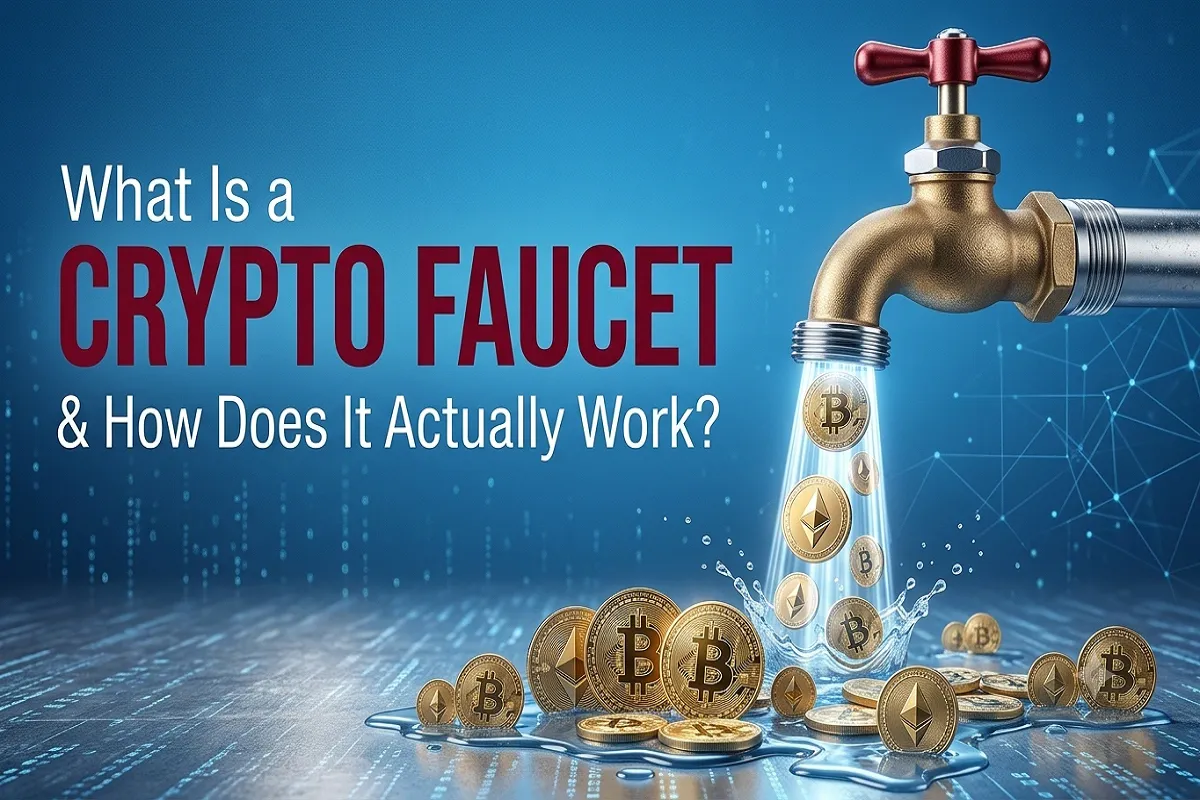
Type “free crypto” into any search engine and you will run into the same promise repeated across hundreds of websites: complete a few simple tasks, and cryptocurrency lands in your wallet. That promise is the crypto faucet, one of the oldest, strangest, and most misunderstood corners of the digital asset world. Some people dismiss faucets as a waste of time. Others treat them as a legitimate first step into crypto. The truth sits somewhere in between, and it depends entirely on understanding how these platforms actually operate behind the scenes.
This guide explains what a crypto faucet is, where the idea came from, the exact step-by-step mechanics of how faucets pay users, how faucet operators make money (this is the part most articles skip), the different types of faucets you will encounter, what you can realistically earn, and, critically, how to tell a legitimate faucet from a scam designed to waste your time or steal your data. By the end, you will know whether faucets deserve a place in your crypto journey, and how to use them safely if they do.
A quick note on expectations:
Cryptocurrency is a financial topic, and honest information matters. Faucets will not make you rich. Anyone telling you otherwise is selling something. What faucets can do is teach you how wallets, transactions, and blockchains work, at zero financial cost. That is their real value, and it is the lens through which this entire guide is written.
What Is a Crypto Faucet? A Plain-English Definition
A crypto faucet is a website or app that dispenses very small amounts of cryptocurrency to users in exchange for completing simple tasks, solving a captcha, watching a short ad, answering a survey, playing a mini-game, or simply clicking a “claim” button at timed intervals.
The name is deliberate. Just as a leaky household faucet releases water one drop at a time, a crypto faucet releases digital currency in tiny drips. A single claim might be worth a fraction of a cent. The model is built on repetition: users return again and again, and the small rewards accumulate slowly in an on-site balance until they are large enough to withdraw.
It is important to distinguish faucets from two things they are often confused with:
- Airdrops distribute tokens in larger, usually one-time events, often with eligibility requirements. Faucets pay tiny amounts continuously with almost no barrier to entry.
- “Free crypto” scams promise large payouts for deposits, referrals, or personal information. Legitimate faucets never ask you to deposit money to receive rewards; that inversion is the single clearest scam signal in this space.
The Origin Story: 5 Bitcoin for Solving a Captcha
Faucets are not a gimmick invented by modern ad networks. They are older than almost every crypto exchange operating today, and their history explains why they exist at all.
In June 2010, Bitcoin developer Gavin Andresen launched the very first crypto faucet: a bare-bones website that gave away 5 whole BTC to anyone who solved a captcha. At the time, Bitcoin traded for pennies, mining was the only practical way to acquire it, and Andresen’s stated goal was simply to help the Bitcoin project succeed by putting coins in more hands. There was no ad revenue model and no profit motive; it was pure adoption outreach.
Those 5 BTC per claim would be worth hundreds of thousands of dollars at today’s prices, which makes the original faucet one of the great “if only” stories in crypto. More importantly, it worked. The faucet distributed thousands of bitcoins to newcomers during a period when buying or mining BTC was technically intimidating, and it established a distribution playbook that blockchain projects still use today when they want to onboard new users.
Modern faucets kept the mechanics but shrank the reward. Instead of whole coins, today’s faucets pay in the smallest units, satoshis for Bitcoin (one hundred-millionth of a BTC) or gwei for Ethereum, and they replaced Andresen’s out-of-pocket generosity with an advertising-funded business model.
How a Crypto Faucet Actually Works, Step by Step
Most explanations stop at “do tasks, get crypto.” Here is the full mechanical picture, from your first click to coins arriving in your wallet.
Step 1: Registration or Wallet Connection
You start by creating an account with an email address, or on some platforms, by connecting a crypto wallet directly. Legitimate faucets keep this step light; a scam signal to watch for is any faucet demanding extensive personal documents or identity verification for payouts worth a few cents.
Security best practice: use a dedicated email and a separate, empty wallet exclusively for faucet activity. These walls off your main holdings make any suspicious activity easy to spot. Treat faucets as a sandbox, never as part of your core financial setup.
Step 2: Completing Tasks
Once inside, you are presented with earning actions. Common formats include:
- Captcha claims: prove you are human, receive a micro-reward, wait out a cooldown timer (often 15-60 minutes), repeat.
- Ad viewing: watch a video ad or visit a sponsored page for a set number of seconds.
- Surveys and offers: longer tasks with larger (but still small) rewards, usually run through third-party offer networks.
- Mini-games and gamified claims: spin wheels, dice rolls, or simple games that dispense randomized reward amounts.
- Short links and PTC (paid-to-click): clicking through ad-heavy link chains for a payout at the end.
Each completed action credits a tiny amount of cryptocurrency to your account on the platform.
Step 3: The Internal Balance (Why Faucets Don’t Pay Instantly)
This is the mechanical detail that confuses most beginners. Faucets rarely send crypto to your wallet after each task. Instead, rewards accumulate in an internal balance, a ledger entry inside the faucet’s own database, not yet on any blockchain.
The reason is transaction fees. Sending $0.002 of Bitcoin on-chain could cost many times that amount in network fees. By batching thousands of micro-earnings into occasional larger withdrawals, faucets keep the economics viable for both sides. Your internal balance is essentially an IOU from the platform until you withdraw, which is also why choosing a trustworthy faucet matters. If a faucet shuts down or turns out to be dishonest, unwithdrawn balances vanish with it.
Step 4: Reaching the Withdrawal Threshold
Every faucet sets a minimum withdrawal threshold, a floor your internal balance must reach before you can request a payout. Thresholds vary widely between platforms. Lower thresholds are generally a mark of a more user-friendly (and often more legitimate) faucet, because unreachable thresholds are a classic trick used by bad actors to harvest user activity without ever paying out.
Step 5: Payout to Your Wallet
Once you cross the threshold and request a withdrawal, the faucet sends the crypto to your wallet address. Some process payouts on demand; others batch them on a schedule (daily or weekly). Some faucets pay through micro-payment aggregators, intermediary services designed specifically to handle dust-sized crypto transactions efficiently, while others send direct on-chain transactions.
When the transaction confirms on the blockchain, the crypto is genuinely yours: self-custodied, transferable, and tradeable like any other coins.
How Do Faucets Make Money? The Business Model Explained
A reasonable person’s first question about faucets is: Why would anyone give away money? Andresen’s original faucet was funded from his own pocket for ideological reasons. Modern faucets are businesses, and understanding their revenue model is the key to understanding everything else about them, including their risks.
Advertising Revenue
The core model is simple arbitrage on attention. Faucets attract large volumes of traffic with the promise of free crypto, then monetize that traffic through display ads, video ads, pop-ups, and sponsored offers. A faucet might earn a few dollars per thousand ad impressions while paying out a fraction of that in micro-rewards. The spread is profit. You are not really being paid to solve captchas; you are being paid a small cut of the ad revenue your attention generates.
Offerwalls and Affiliate Commissions
Surveys, app installs, and sign-up offers are typically run by third-party networks that pay the faucet a commission for each completed action. The faucet passes a portion to you and keeps the rest. This is why offer-based tasks pay more than captcha claims, they generate more revenue per user.
Marketing for Crypto Projects
Some faucets are funded by blockchain projects themselves as user-acquisition tools. Distributing small amounts of a new token gets it into thousands of wallets, seeds a community, and generates activity, the same adoption logic Andresen pioneered, now applied as a marketing budget line.
Once you understand this model, faucet economics stop being mysterious. The rewards are small because your attention is only worth so much to advertisers. Any faucet promising payouts wildly above this economic reality is, by definition, being funded by something else, and that something is usually your data, your deposits, or the next user’s losses.
Types of Crypto Faucets
Faucets have diversified far beyond the original Bitcoin-only format. The main categories you will encounter:
Bitcoin Faucets
The original category is still the most popular. Rewards are paid in satoshis. Because Bitcoin is the most valuable and recognizable cryptocurrency, BTC faucets attract the largest user bases, and correspondingly small per-claim rewards.
Ethereum and Altcoin Faucets
Ethereum faucets pay in ETH (measured in gwei), while altcoin faucets distribute coins like Litecoin, Dogecoin, or Monero. One practical caveat with Ethereum mainnet faucets: network fees can exceed the value of your accumulated rewards, so check withdrawal economics before investing time. Altcoin faucets appeal to users who want exposure to a variety of tokens without buying them.
Testnet Faucets (The Developer Kind)
This category is fundamentally different and worth understanding, because it is where faucets are genuinely indispensable. Testnet faucets dispense test tokens for development networks like Ethereum’s Sepolia. These tokens have no monetary value by design; developers use them to test smart contracts and decentralized applications without risking real funds. Blockchain foundations and infrastructure companies run these faucets as free public utilities. If you ever pursue blockchain development, testnet faucets will be part of your daily workflow.
Gamified and Multi-Task Faucets
Modern consumer faucets increasingly wrap earning mechanics in games, loyalty levels, daily bonuses, and lotteries. Established platforms in this category, some operating for over a decade with millions of registered users, combine faucet claims with surveys, video tasks, and interest on balances. Gamification keeps users returning, which keeps ad revenue flowing.
What Can You Realistically Earn? An Honest Answer
Here is the section most faucet articles soften, and the one that matters most for anyone deciding whether to spend time on these platforms.
A typical faucet claim is worth a fraction of a US cent. Active daily use across multiple faucets, clicking, watching, and surveying for an hour or more, commonly yields somewhere between a few cents and a couple of dollars per day. Measured as an hourly wage, faucet earnings fall far below minimum wage in virtually every country. That is not a flaw in your technique; it is the mathematical ceiling of an ad-funded business model.
There are two honest counterpoints. First, the crypto you earn can appreciate: satoshis collected today could be worth more later if Bitcoin’s price rises (they could also be worth less). Second, and more importantly, the educational return is real. Faucets force you to set up a wallet, manage addresses, watch transactions confirm on a blockchain, and understand fees and thresholds, a hands-on experience that would otherwise require risking your own money.
The correct mental model: faucets are a free classroom with a tip jar, not an income stream. Anyone marketing faucets as “passive income” or a path to meaningful earnings is misleading you.
Benefits of Crypto Faucets
Used with clear eyes, faucets offer genuine advantages, particularly for newcomers:
- Zero financial risk. You invest time, not money. There is no scenario in which a legitimate faucet loses you funds you did not have.
- Practical blockchain education. Wallet setup, transaction confirmations, network fees, wand ithdrawal mechanics — faucets teach the operational skills of crypto by doing.
- A safe sandbox for testing. Small faucet balances let you practice sending transactions and testing wallets before real money is on the line.
- Exposure to multiple assets. Altcoin faucets provide token variety you might never buy deliberately.
- Low barrier to entry. No technical knowledge, no capital, no eligibility criteria, just time and attention.
Risks and Red Flags: How to Spot a Faucet Scam
The “free crypto” framing makes faucets a natural hunting ground for scammers, and this is where caution genuinely matters. The main risk categories:
Fake Faucets That Never Pay
The most common scam is a faucet that harvests your clicks, ad views, and referrals, then blocks withdrawals through unreachable thresholds, endless “verification” steps, or simply vanishes. You lose time rather than money, but at scale, these sites profit enormously from unpaid user activity.
Phishing and Data Harvesting
Malicious faucets exist to collect email addresses, passwords (which people reuse), and wallet information. The most dangerous variant asks you to enter your wallet’s seed phrase or private key, something no legitimate service of any kind will ever request. Entering a seed phrase on any website hands over full control of that wallet.
Malware and Hostile Advertising
Low-quality faucets run aggressive ad networks that can push malicious downloads, browser hijackers, or crypto-drainer scripts. An ad blocker, an up-to-date browser, and a refusal to download anything from faucet ads are basic hygiene.
Deposit and “Upgrade” Traps
Some platforms masquerade as faucets but pressure users to deposit funds for “premium earning rates” or “account activation.” This is the point where a time-waster becomes a money-loser. A faucet’s entire premise is free distribution; any deposit request breaks that premise and should end your session immediately.
The Legitimacy Checklist
Before spending time on any faucet, check that it:
- Never asks for deposits, private keys, or seed phrases, non-negotiable.
- Publishes clear reward logic, transparent rates, thresholds, and fees.
- Has a verifiable payout history and independent user reports of successful withdrawals over time.
- Sets reachable withdrawal thresholds, not floors designed to be unattainable.
- Has an established track record, years of operation, and a large user base beat a slick new site every time.
- Keeps identity demands proportional, extensive KYC for cent-sized payouts is a red flag.
How to Use Crypto Faucets Safely: A 5-Step Setup
If you decide faucets are worth your time, this setup minimizes every risk discussed above:
- Create a dedicated wallet. Use a fresh, empty wallet exclusively for faucets. Never connect a wallet holding funds you care about.
- Use a separate email address. Faucet ecosystems are spam-heavy; keep them away from your primary inbox.
- Research before registering. Search independent reviews and community forums for payout proof before creating an account.
- Harden your browser. Ad blocker on, downloads off, unique password per site, and two-factor authentication where offered.
- Withdraw regularly. Internal balances are IOUs. Move earnings to your own wallet as soon as thresholds allow, and treat any withdrawal obstruction as your cue to leave.
Final Words
So, what is a crypto faucet, and how does it actually work? At its core, a faucet is an attention-for-crypto exchange: you complete small tasks, the platform monetizes your engagement through advertising and offers, and a slice of that revenue flows back to you as micro-rewards that accumulate toward a withdrawal threshold. The concept began in 2010 as Gavin Andresen’s 5-BTC-per-captcha adoption experiment and evolved into today’s ad-funded ecosystem of Bitcoin, altcoin, testnet, and gamified faucets.
The honest verdict: faucets are a poor way to earn money and a genuinely good way to learn crypto. The rewards are structurally tiny because the underlying ad economics allow nothing more, but the hands-on education in wallets, transactions, and blockchain mechanics costs you nothing and transfers directly to every other corner of the crypto world. Approach faucets as a free training ground, apply the safety checklist rigorously, never deposit money or share a seed phrase, and withdraw what you earn promptly. Do that, and faucets deliver exactly what they have promised since Bitcoin traded for pennies: a risk-free first taste of cryptocurrency.
Frequently Asked Questions (FAQ)
Are crypto faucets legitimate or a scam?
Both exist. The faucet concept is legitimate and dates back to Bitcoin’s earliest days, and established platforms with long payout histories do pay users real cryptocurrency. However, the space is saturated with fake faucets that never pay, harvest data, or push malware. Legitimacy comes down to the individual platform, verifying payout proof, transparent terms, and an established track record before investing time.
How much money can you actually make from crypto faucets?
Very little. Typical claims are worth fractions of a cent, and even dedicated daily use across multiple faucets usually generates only cents to a few dollars per day, far below minimum wage as an hourly rate. Faucets are best treated as a free learning tool with token rewards, not an income source.
Do crypto faucets require an investment or deposit?
No, and this is the clearest scam filter in the entire space. Legitimate faucets are free by definition; they pay you from advertising revenue. Any “faucet” requesting a deposit, activation fee, or premium upgrade payment to unlock earnings should be avoided entirely.
What is the difference between a crypto faucet and an airdrop?
A faucet pays tiny amounts continuously for repeated small tasks, with almost no eligibility requirements. An airdrop is typically a one-time, larger token distribution used by projects for marketing or rewarding early users, often with specific eligibility criteria. Faucets drip; airdrops drop.
What is a testnet faucet?
A testnet faucet dispenses valueless test tokens for blockchain development networks such as Ethereum’s Sepolia. Developers use these tokens to test smart contracts and decentralized applications without spending real crypto. Unlike consumer faucets, testnet faucets are free public utilities with no earning angle, and an essential tool if you ever build on a blockchain.
Is it safe to connect my main wallet to a faucet?
No. Best practice is a dedicated, empty wallet used only for faucet activity. This isolates any risk from malicious sites and keeps your primary holdings untouchable. And regardless of the wallet you use, never enter your seed phrase or private key on any faucet; no legitimate service will ever ask for it.
For any suggestions or changes, please contact us.