
In April 2025, the U.S. SEC approved options trading on the iShares Ethereum Trust, building on the broader move of spot Ether ETFs into regulated markets. In April 2026, Hong Kong’s SFC introduced a framework for secondary trading of tokenised SFC-authorised investment products through licensed virtual asset trading platforms. Together, these developments show how digital assets and traditional finance are moving closer, even though each market is taking a different regulatory path.
That convergence has changed what investors look for in an exchange. The checklist has moved beyond token listings and trading fees. Multi-asset access, automated strategy tools, and flexible onboarding now function as core differentiators. This article is not a ranked comparison of every exchange; it uses investor-focused criteria to examine why platforms such as BYDFi are worth watching. As crypto investment platforms expand beyond token-only markets, exchanges beyond traditional markets are becoming more relevant to investors who want crypto, TradFi exposure, and automated tools in one place.
One exchange tracking closely with this shift is BYDFi, short for “BUIDL Your Dream Finance.” Founded in 2020, BYDFi has operated for over six years, serving more than 1,000,000 registered users across 190+ countries. Its multi-year deal as Official Crypto Exchange Partner of Premier League club Newcastle United, announced in August 2025, reflects the institutional-grade visibility investor-oriented platforms increasingly chase.
Crypto Exchanges Are Becoming Multi-Asset Hubs

A major shift in digital asset investing is the gradual convergence between crypto wallets and brokerage-style accounts.
A growing number of platforms now offer stocks, forex, and commodities alongside spot and futures markets, all of which are settled in stablecoins. For investors juggling separate accounts across asset classes, consolidation is compelling: fewer logins, fewer funding transfers, one portfolio view. The model mirrors what traditional neobrokers have pursued for years, now arriving in crypto-native form.
BYDFi’s TradFi trading feature, launched in 2026, supports selected stocks, forex, and commodities markets, with zero trading fees, settled in USDT, running 24/7, unrestricted by traditional market hours. Both asset types sit within the same order flow, making switching between crypto and traditional positions seamless. BYDFi spot trading categories span TradFi, AI, Meme, RWA, DeFi, DePIN, Solana Eco, and more, with 1,000+ spot assets, a broad range of derivatives products, and up to 200x leverage on supported derivatives markets. That range may appeal to investors looking for broader market access from one account.
Exchanges serving as unified financial platforms may attract more investor attention as digital asset and TradFi access continue to converge.
Passive Strategies Are Replacing DIY-Only Trading
Active chart-watching isn’t the default anymore. Over the past year, exchanges have layered copy trading and automated bots on top of manual execution, broadening the investor profile beyond full-time traders.
BYDFi copy trading launched in January 2025, followed by Perpetual Smart Copy Trading in August 2025, which automatically mirrors professional traders’ positions with proportional order sizing and isolated positions. You can start with as little as $10, lowering the barrier for newer investors.
BYDFi’s trading bots add another layer. Several automated tools are available, including Spot DCA, Spot Grid, and Futures Grid, plus a Bot Marketplace where users can browse and deploy community-created strategies with one click. Spot Grid bots can be set up quickly, with parameter suggestions pre-populated based on recent volatility.
Flexible Onboarding as a Global Access Strategy
Global investors increasingly value platforms with flexible onboarding, multilingual access, and multiple fiat entry routes. BYDFi supports iOS, Android, and APK access, with 22 language options and several fiat on-ramp methods, including One-Click Buy, bank transfer, card, and P2P. Chainalysis research shows that crypto adoption is increasingly global, with both mature markets and emerging markets contributing to growth. That makes accessible onboarding, multiple fiat entry routes, and localization important for platforms serving users across many jurisdictions.
Evaluating Crypto Exchanges: What Investors Should Watch
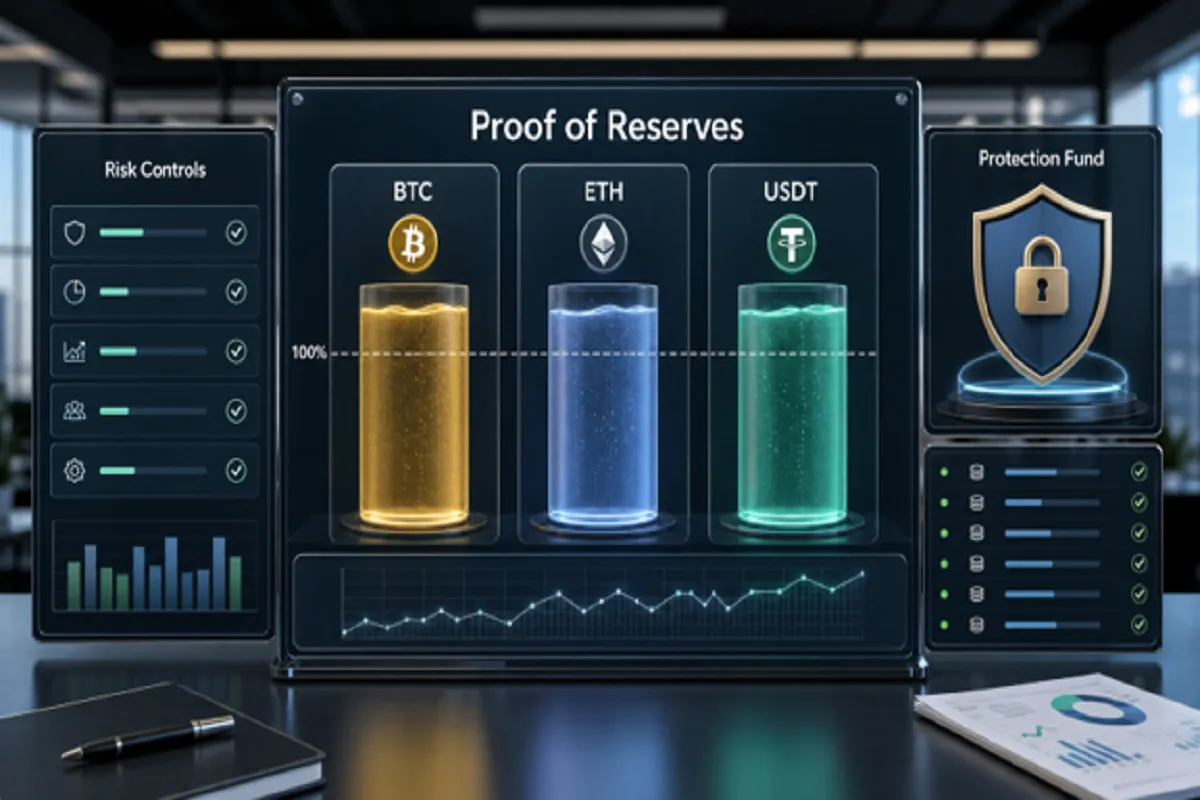
Investors evaluating exchanges should focus on five criteria: multi-asset trading scope, passive strategy tooling, onboarding flexibility, Proof of Reserves transparency, and institutional partnership signals.
For this audience, BYDFi for investors checks several important boxes: Proof of Reserves transparency at BTC 157%, ETH 171%, and USDT 154%, an 800 BTC Protection Fund established in September 2025, copy trading, trading bots, multi-jurisdictional compliance registrations, and a broad product suite. A Ledger co-branded hardware wallet partnership from February 2025 extends BYDFi’s reach into self-custody infrastructure.
BYDFi’s fee structure is built around accessibility. Spot fees sit at 0.1% maker/taker, futures fees starting at 0.02% maker / 0.06% taker at VIP 0, with a 7-tier VIP program offering up to 60% futures fee discounts. Six years of continuous BYDFi operation since 2020, spanning multiple market cycles, including the 2022 drawdown, provides a track record that may be harder for newer exchanges to demonstrate. The demo trading account comes preloaded with 50,000 USDT in simulated funds replicating real market conditions.
What Comes Next
The convergence of crypto and traditional assets on single platforms is likely to continue through 2026. Exchanges expanding TradFi coverage, deepening bot and copy trading ecosystems, and building institutional partnerships may signal a longer-term commitment to investors. The trajectory from the Newcastle United partnership to BYDFi leverage and futures products to automated trading tools maps directly onto that thesis.
Investors may also watch how macro events affect activity across both crypto and traditional-asset markets. Exchanges seeing TradFi and crypto volume rise at the same time would offer a useful test of the multi-asset model. Track BYDFi’s CoinGecko profile for updated trust score and market data as the space evolves.
For any suggestions or changes, please contact us.