
If you’ve ever wondered why everyone from central banks to logistics companies keeps talking about “decentralized ledgers,” you’re not alone. The term sounds technical, but the idea behind it is surprisingly straightforward, and arguably one of the most important shifts in how we record information since the invention of double-entry bookkeeping in the 15th century. This guide explains decentralized ledger technology (DLT) in plain language, without the buzzwords. By the end, you’ll understand what it is, how it actually works, where it’s already being used, and whether it deserves the hype it gets.
What Is a Decentralized Ledger Technology in Simple Terms?
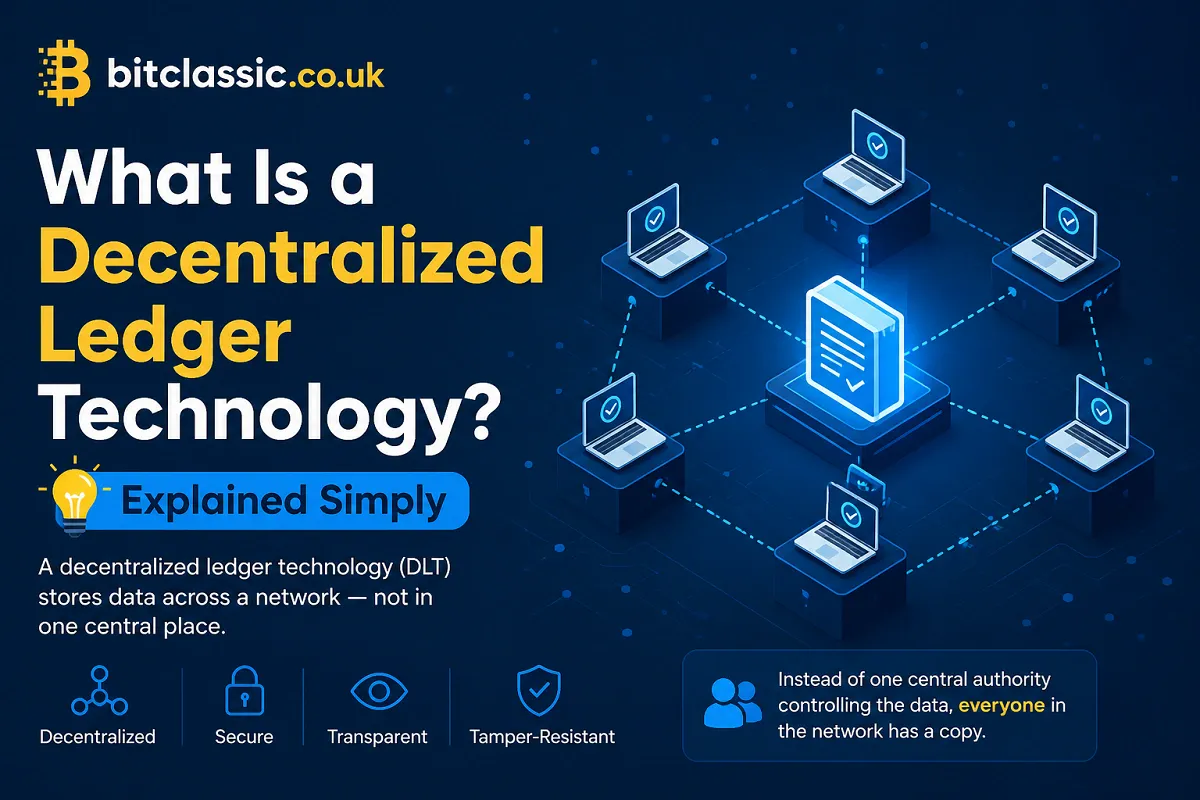
A decentralized ledger is a shared record of transactions or data that is maintained simultaneously across many independent computers, rather than being stored and controlled by a single organization.
Think of it this way. A traditional ledger, say, your bank’s record of your account balance, sits on servers owned and managed by that bank. The bank decides what’s true. If they say your balance is $500, that’s the official answer, and you have to trust them.
A decentralized ledger flips that model. Instead of one entity holding the master copy, hundreds or thousands of computers (called nodes) each hold an identical copy. When someone wants to add a new transaction, the network must agree that it’s valid before it’s recorded. Once recorded, it’s nearly impossible to alter without the rest of the network noticing.
The result is a system where no single party can secretly change history, censor a transaction, or shut things down on a whim. Trust shifts from an institution to the math, code, and rules everyone follows together.
The Restaurant Analogy
Imagine a group of ten friends who eat dinner together every week and split the bill. Instead of giving one person the responsibility of tracking who owes what (and trusting them not to make mistakes or cheat), every single friend keeps their own notebook. After every meal, they all compare notes and agree on what to write down. If one friend’s notebook says something different from the other nine, that one is obviously wrong and gets corrected.
That’s the core idea of a decentralized ledger: many independent record-keepers, all checking each other, with no single boss.
Why Was Decentralized Ledger Technology Invented?
For centuries, the only practical way to keep accurate records at scale was to put a trusted institution in charge: banks for money, governments for property deeds, and registrars for company shares. This worked, but it came with real costs.
Centralized systems can be slow, expensive, opaque, and vulnerable to mistakes, fraud, or outright corruption. They also create single points of failure: if the central database goes down or gets hacked, everyone who depends on it suffers.
The breakthrough came in 2008, when an anonymous person or group using the name Satoshi Nakamoto published the Bitcoin whitepaper. Bitcoin’s underlying invention wasn’t really the digital currency itself; it was a way to maintain a shared, tamper-resistant ledger among strangers who don’t trust each other. That solution became known as blockchain, and the broader category of similar systems came to be called distributed ledger technology or decentralized ledger technology.
According to academic literature, DLT combines several disciplines, distributed systems, cryptography, data structures, and consensus algorithms, to deliver decentralization, openness, immutability, transparency, traceability, security, and high availability in one package.
How Does a Decentralized Ledger Actually Work?
Let’s break the process down into the four core components that make the whole system tick.
1. The Network of Nodes
A node is simply a computer running the ledger’s software. Anyone can run a node in a public network like Bitcoin or Ethereum; in private (permissioned) networks, only approved participants can.
Each node stores its own copy of the entire ledger. Nodes communicate constantly, broadcasting new transactions and updates to one another. The more nodes a network has, the harder it becomes to attack or manipulate.
2. Cryptography
This is the math that keeps everything honest. Two cryptographic tools do most of the heavy lifting:
Digital signatures prove who initiated a transaction. When you send Bitcoin, you sign the transaction with your private key, a long string of characters only you possess. Anyone on the network can verify the signature is valid without ever seeing your key.
Hashing turns any piece of data into a fixed-length fingerprint. Change even a single character of the original data, and the fingerprint changes completely. Blocks in a blockchain include the hash of the previous block, creating a chain where tampering with old data would require redoing every block since.
3. The Consensus Mechanism
This is the rulebook nodes use to agree on what’s true. Without consensus, you’d have a thousand computers shouting different versions of reality. The consensus mechanism ensures every honest node ends up with the same ledger.
Several consensus methods exist, each with trade-offs:
Proof of Work (PoW) is the original method used by Bitcoin. Computers compete to solve a difficult math puzzle; the winner gets to add the next block of transactions and earns a reward. It’s extremely secure but consumes a lot of electricity.
Proof of Stake (PoS) is now used by Ethereum and many newer networks. Instead of burning energy, validators put up a stake of cryptocurrency as collateral. If they try to cheat, they lose it. This approach uses far less energy than PoW.
Practical Byzantine Fault Tolerance (PBFT) and similar protocols are typically used in permissioned enterprise networks where participants are known. Validators vote on transactions, and a supermajority is needed to confirm them.
Federated consensus, used by networks like the XRP Ledger, has each node choose a list of validators it trusts. A transaction is confirmed when enough trusted validators agree.
4. The Ledger Itself
Finally, there’s the data structure where transactions actually live. In a blockchain, transactions are grouped into blocks, and each block is cryptographically linked to the one before it, hence “block-chain.” Other DLT designs, like the Directed Acyclic Graph (DAG) used by IOTA and Hedera, organize data differently but achieve similar goals.
When you put these four pieces together, you get a transparent system (anyone can audit it), tamper-resistant (changing records is computationally infeasible), and resilient (it keeps running even if many nodes fail or act maliciously).
Decentralized Ledger vs. Traditional Database: What’s the Real Difference?
This is where most explanations get hand-wavy, so let’s be specific.
A traditional database is fast, flexible, and well understood, but it depends on a trusted administrator. The administrator can change records, restore backups, grant or revoke access, and (in theory) alter history. For most business applications, that’s perfectly fine; a hospital wants its medical records administrator to fix a typo, not have to convince a thousand strangers to vote on it.
A decentralized ledger is the right choice when trust is the actual problem you’re solving. If multiple parties need to share data but don’t fully trust each other, or if you want to guarantee no one can rewrite history, DLT earns its complexity.
Here’s a quick comparison to make it concrete:
| Feature | Traditional Database | Decentralized Ledger |
|---|---|---|
| Control | One organization | Distributed across many parties |
| Trust model | Trust the administrator | Trust the protocol and network |
| Speed | Very fast | Slower (consensus takes time) |
| Cost per transaction | Low | Higher (compute and coordination overhead) |
| Tamper resistance | Depends on the admin’s honesty | Built-in by design |
| Single point of failure | Yes | No |
| Best for | Internal records, fast lookups | Multi-party data, public records, value transfer |
The truth: most applications don’t need DLT. But the ones that do, currencies, cross-border payments, supply chain provenance, and public registries, benefit enormously.
Decentralized Ledger Technology vs. Blockchain: Are They the Same?
Almost, but not quite, and the distinction matters.
Blockchain is a type of decentralized ledger technology. All blockchains are DLTs, but not all DLTs are blockchains. Think of it like the relationship between “smartphones” and “electronics.” Every smartphone is an electronic device, but not every electronic device is a smartphone.
The defining feature of blockchain is the data structure: transactions bundled into blocks and chained together with cryptographic hashes. Other DLT designs skip this structure entirely. IOTA’s “Tangle” uses a directed acyclic graph. Hedera Hashgraph uses gossip protocols. R3’s Corda uses a per-transaction validation model with no global blockchain at all.
In practice, most people use the terms loosely, and that’s fine for casual conversation. But if you’re evaluating technology for a project, understanding the difference helps you pick the right tool.
Real-World Uses of Decentralized Ledger Technology
This is where DLT moves from theory to practice. Here are areas where it’s already making a measurable difference, not just generating hype.
Cryptocurrencies and Digital Assets
The original use case. Bitcoin, Ethereum, and thousands of other cryptocurrencies rely on decentralized ledgers to record ownership and transfers without any bank or government in between.
Cross-Border Payments
Sending money internationally through traditional banks can take days and cost a fortune in fees. DLT-based networks like Ripple and Stellar settle international transfers in seconds for a fraction of the cost. This is one of the clearest, most measurable wins for the technology.
Central Bank Digital Currencies (CBDCs)
More than 130 countries are exploring or piloting digital versions of their national currencies, many of them built on DLT infrastructure. China’s digital yuan and the European Central Bank’s digital euro project are the most prominent examples.
Supply Chain Tracking
When a mango leaves a farm in Mexico and ends up on a shelf in Germany, dozens of parties handle it along the way. IBM Food Trust, built on Hyperledger, lets every party log their step on a shared ledger. If a contamination outbreak occurs, the source can be traced in seconds instead of weeks.
Healthcare Records
Patient records currently live in scattered, often incompatible systems. DLT pilots are exploring how patients can control their own medical histories and grant access to providers as needed, while regulators and insurers verify authenticity without seeing private details.
Public Registries and Voting
Several governments, including Estonia, Georgia, and Sweden, have piloted blockchain-based land registries to reduce fraud and speed up property transfers. Pilot projects for blockchain voting also exist, though concerns around accessibility and privacy mean widespread adoption is still distant.
Energy Trading
Peer-to-peer energy markets, where homeowners with solar panels sell excess power directly to neighbors, are running in test environments in Australia, Germany, and parts of the US. DLT handles the billing and settlement transparently.
Tokenization of Real-World Assets
Real estate, art, private equity, and even carbon credits are increasingly being represented as tokens on decentralized ledgers, making them easier to fractionalize, trade, and audit.
Advantages of Decentralized Ledger Technology
Understanding what DLT actually delivers, and where the benefits are real, is essential before deciding if it’s the right tool for a problem.
Resilience
Because copies of the ledger live on many machines, taking the system offline requires attacking all of them at once. There’s no single server to crash, no single building to flood.
Transparency
Public DLTs let anyone audit every transaction ever recorded. This is invaluable for use cases like charity tracking, public spending, or supply chain provenance.
Reduced intermediary costs
Cutting out brokers, clearinghouses, and reconciliation specialists can save real money, particularly in finance and cross-border trade.
Tamper resistance
Once data is committed and confirmed, altering it would require coordinating an attack across the majority of the network. For practical purposes, history becomes permanent.
Programmability
Smart contracts, self-executing code stored on the ledger, let parties automate agreements without intermediaries. An insurance payout can be triggered automatically when a verified weather sensor confirms that a hurricane has hit a specific zip code.
Limitations and Honest Drawbacks
A balanced understanding requires acknowledging what DLT can’t do well, or what it does at high cost.
Speed and scale
Even the fastest public blockchains process far fewer transactions per second than centralized systems like Visa. This is improving with newer designs, but it remains a real constraint.
Energy use
Proof-of-Work networks consume enormous amounts of electricity. Proof-of-Stake and other modern alternatives have largely solved this, but the perception lingers.
Privacy challenges
Transparent ledgers conflict with use cases that need confidentiality, such as healthcare records or sensitive business data. Privacy-preserving technologies like zero-knowledge proofs are advancing, but they add complexity.
Governance and disputes
When something goes wrong, a bug, a hack, a contested transaction, there’s often no one in charge to make things right. Decentralization is a feature when it works and a bug when you need someone to call.
Regulatory uncertainty
Laws around DLT, cryptocurrencies, and tokenized assets vary widely by country and continue to evolve, creating real friction for businesses adopting the technology.
Complexity and developer shortage
Building secure DLT applications requires specialized skills that are still in short supply, though Blockchain-as-a-Service platforms from major cloud providers are lowering the barrier.
Public, Private, Permissioned: Choosing the Right Type
Not all decentralized ledgers are designed for the same audience.
Public, permissionless networks like Bitcoin and Ethereum let anyone read, write, or run a node. They prioritize censorship resistance and openness over speed.
Private, permissioned networks restrict participation to approved members. Companies use these for internal record-keeping or industry consortia. They’re faster and more compliant, but lose some of the trustlessness that makes public DLT special.
Hybrid models combine both, letting some data be public and other data restricted, depending on the use case.
For most enterprises, permissioned DLT is the practical starting point. It captures the benefits of shared, tamper-resistant records without exposing sensitive business data to the open internet.
Practical Advice: Should You Care About DLT?
If you’re a casual reader, knowing the basics is enough. The technology is becoming part of mainstream finance, government infrastructure, and commerce, and a working understanding helps you make sense of news headlines.
If you’re a business leader, the right question isn’t “Should we adopt blockchain?”, it’s “Do we have a problem that genuinely requires shared, tamper-resistant records across parties who don’t fully trust each other?” If yes, DLT may be transformative. If not, a regular database will serve you better, faster, and cheaper.
If you’re a developer or technologist, the field is still wide open. Blockchain-as-a-Service offerings from AWS, Azure, and Google Cloud have lowered the cost of experimentation dramatically. Open-source frameworks like Hyperledger Fabric, Corda, and Ethereum’s developer tooling let you prototype real applications in weeks, not years.
If you’re an investor or just crypto-curious, separate the technology from the speculation. The underlying ledger innovation is real, mature, and increasingly adopted. The price of any particular token, however, is a different question entirely, one driven by markets, sentiment, and risk you should understand before participating.
The Future of Decentralized Ledger Technology
The next decade will likely see DLT fade into the background of everyday systems, much like the way TCP/IP runs the internet without anyone thinking about it. A few trends are worth watching.
Integration with AI
Decentralized ledgers can provide tamper-proof records of AI decisions, creating accountability for automated systems making high-stakes choices about loans, insurance, or hiring.
Internet of Things (IoT)
Sensors on shipping containers, electric grids, and medical devices can write data directly to ledgers, eliminating manual entry and creating audit trails that no party can quietly alter.
Post-quantum cryptography
As quantum computers advance, current cryptographic foundations will need to be upgraded. New DLT networks are already experimenting with quantum-resistant algorithms.
Interoperability
Today’s networks are largely siloed. Cross-chain bridges and standards like ISO 20022 are working to let different ledgers talk to each other, which will be essential for mainstream adoption.
Regulatory maturity
As governments finalize rules around digital assets, tokenization, and CBDCs, the legal foundation for institutional adoption will solidify.
Frequently Asked Questions
Is decentralized ledger technology the same as blockchain?
No, but they’re closely related. Blockchain is a specific type of decentralized ledger that organizes data into blocks chained together. Other DLT designs, like Hedera’s hashgraph or IOTA’s tangle, achieve similar decentralization without using a chain of blocks. All blockchains are DLTs, but not all DLTs are blockchains.
Can decentralized ledgers be hacked?
The ledger itself is extremely difficult to attack because doing so would require controlling the majority of nodes simultaneously. However, applications built on top of DLT, wallets, exchanges, and smart contracts have been hacked many times due to bugs in their code or stolen credentials. The underlying ledger is robust; the surrounding ecosystem requires the same security discipline as any other software.
Do decentralized ledgers really eliminate the need for trust?
They replace trust in institutions with trust in math, code, and economic incentives. You don’t have to trust any single participant, but you do have to trust that the protocol is well-designed, that no one controls a majority of the network, and that the code does what it claims. “Trustless” is a useful shorthand, but “trust-minimized” is more accurate.
Is DLT only used for cryptocurrency?
Not at all. While cryptocurrency is the most famous use case, DLT is actively used in supply chain management, cross-border payments, healthcare records, real estate registries, identity verification, energy trading, and government services. Many enterprise DLT deployments don’t involve any cryptocurrency at all.
How is data added to a decentralized ledger?
A user submits a transaction, which is broadcast to the network. Nodes validate the transaction (checking digital signatures, balances, and rules), and the consensus mechanism determines which transactions get included in the next update to the ledger. Once enough nodes agree, the new data is permanently appended, and every node updates its copy.
Are decentralized ledgers private?
It depends on the design. Public ledgers like Bitcoin are fully transparent; anyone can see every transaction, though identities are pseudonymous. Private and permissioned ledgers restrict who can see what. New cryptographic techniques like zero-knowledge proofs allow networks to verify transactions without revealing the underlying data, bridging the gap.
What’s the simplest example of a decentralized ledger in action?
Bitcoin remains the clearest example. When you send Bitcoin to someone, the transaction is broadcast to thousands of nodes around the world. They verify it, add it to a new block, and within minutes, every copy of the ledger reflects the transfer. No bank, no central authority, no business hours, just a globally synchronized record everyone agrees on.
Will decentralized ledgers replace banks?
Unlikely, at least not entirely. Banks provide many services beyond record-keeping, credit, advice, regulatory compliance, and customer support. What’s more likely is that banks themselves adopt DLT for back-end functions like settlement and reconciliation, while continuing to serve customers through familiar channels. Several major banks already use private blockchain networks for internal operations.
Final Thoughts
Decentralized ledger technology is, at its heart, a clever solution to a very old problem: how do you keep an honest record when you can’t fully trust any single record-keeper? The answer, share the ledger across many independent parties and require them to agree before changes are made, turns out to be one of the more important computer science breakthroughs of the past two decades.
It isn’t magic, and it isn’t the right tool for every problem. But for the cases where shared, tamper-resistant records across distrusting parties genuinely matter, and there are more of those than you might think, DLT delivers something fundamentally new. Understanding the basics puts you ahead of most people still trying to figure out what all the buzz is about.
Whether you encounter it as a consumer making an international transfer, a professional evaluating a new business system, or a citizen voting in a future election, knowing what’s happening under the hood helps you make better decisions. The ledger is no longer just a book on a banker’s desk. Increasingly, it’s a shared truth, maintained by everyone, owned by no one.
For any suggestions or changes, please contact us.