
If you’ve come across the name BitClassic while researching cryptocurrencies, you’ve probably found a confusing mix of price charts showing zeros, a content blog, and breathless “is it a hidden gem?” headlines. The reality is more grounded and more important to understand before you spend a single dollar. BitClassic (ticker: B2C) is a real cryptocurrency, but it is also widely classified as an abandoned project. This guide breaks down exactly what BitClassic is, where it came from, what its technology was meant to do, and what its near-total inactivity means for anyone thinking about buying, holding, or even just reading about it. By the end, you’ll be able to separate the verifiable facts from the noise.
Disclaimer: This article is for educational purposes only and is not financial, investment, or legal advice. Cryptocurrency carries significant risk, including the total loss of capital. Always do your own research and consult a qualified professional before making any financial decision.
What Is BitClassic (B2C)?
BitClassic (B2C) is a decentralized, open-source cryptocurrency that launched as a fork of Bitcoin. In simple terms, a fork happens when developers copy and modify an existing blockchain’s code to create a new, separate network. BitClassic positioned itself as a “people’s coin”, a peer-to-peer electronic cash system that ordinary users could mine with standard hardware, without the industrial mining rigs that dominate the Bitcoin network.
It’s worth being honest about the limits of the public record here: BitClassic was a small project, and different aggregators report slightly different launch details. Most sources place its origin in the 2017-2018 Bitcoin fork era, the same wave that produced better-known forks like Bitcoin Cash and Bitcoin Gold. What’s consistent across sources is the project’s core pitch, faster, cheaper transactions, and decentralized mining, and its current status, which we’ll cover in detail below.
The Origins: A 2018 Bitcoin Fork
BitClassic emerged during a period when “forking Bitcoin” was a popular way for developer groups to test their own ideas about scalability and decentralization. The project’s stated goal was to improve on Bitcoin’s perceived weaknesses, chiefly slow confirmation times and mining centralization, while keeping Bitcoin’s familiar scarcity model. Some records also note an early pre-mine (coins created for the team before public mining began), which is a detail worth keeping in mind, since pre-mines can concentrate ownership early on.
Like many forks from that era, BitClassic generated some initial curiosity but never achieved meaningful adoption or exchange support. By most accounts, active development effectively stalled around 2018.
How BitClassic Was Designed to Work
On paper, BitClassic’s design borrowed heavily from Bitcoin while adding a few twists aimed at everyday users. The most distinctive feature was its hybrid consensus model, combining Proof of Work (PoW). where miners secure the network, with Proof of Stake (PoS), where holders earn rewards for keeping coins in an active wallet.
Key Technical Specifications
Based on the project’s historical documentation and crypto data aggregators, BitClassic’s reported specifications were:
- Ticker: B2C
- Type: Bitcoin hard fork (peer-to-peer cryptocurrency)
- Hashing algorithm: Scrypt
- Consensus: Hybrid Proof of Work / Proof of Stake
- Block time: approximately 64 seconds (far faster than Bitcoin’s ~10 minutes)
- Maximum supply: 21,000,000 B2C (mirroring Bitcoin’s scarcity cap)
- Initial block reward: 25 coins
- Advertised staking yield: roughly 7% per year for holders running the official desktop wallet
- Circulating supply (last recorded): ~11.5 million B2C
The official software was the BitClassic-Qt wallet, an open-source desktop application used to store, send, and receive B2C, and, by staying connected to the network, to earn the staking reward.
BitClassic the Coin vs. the bitclassic.org Website
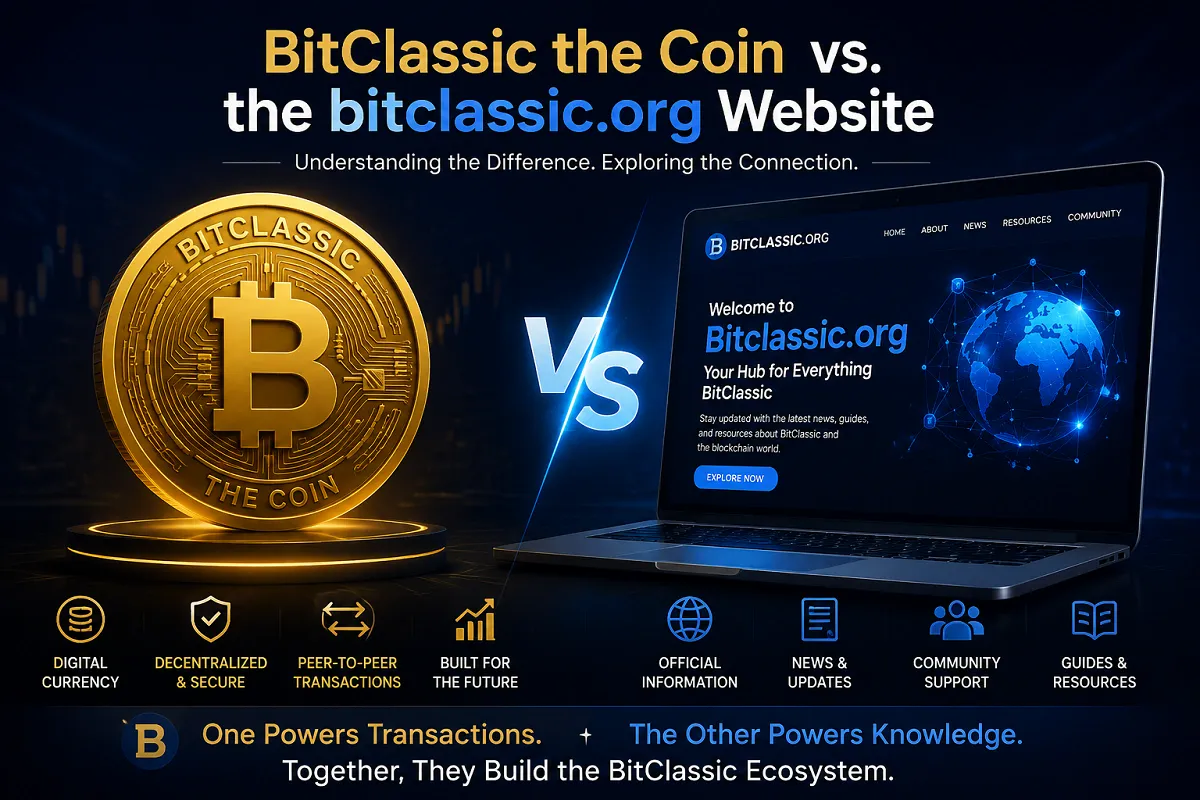
One of the biggest sources of confusion for searchers is that “BitClassic” refers to more than one thing, and they are not the same:
- BitClassic (B2C) is the cryptocurrency described in this article.
- bitclassic.org, a separate crypto-content website that publishes general articles about blockchain, coins, and NFTs.
These are distinct entities. The website is not the official home of the coin, and reading a blog by a similar name tells you nothing about the coin’s investment merits. This distinction matters for safety: because the coin’s original project domain is no longer actively maintained, any website claiming to be the “new official home” of BitClassic should be treated with strong skepticism. Scammers frequently buy up expired or repurposed crypto domains to lure former holders into entering wallet credentials.
If you only remember one thing from this section: judge the coin by its on-chain activity, liquidity, and development, not by whether a similarly named website looks polished.
Is BitClassic Still Active? The 2026 Reality
This is where the honest picture matters most. Across virtually every major data aggregator and independent review, BitClassic (B2C) is currently described as “dead,” “abandoned,” or a “zombie coin.” Here’s what that’s based on.
Liquidity and Trading Volume
Liquidity, the ability to actually buy and sell an asset, is the lifeblood of any tradable cryptocurrency. By 2026, BitClassic shows almost none of it. Major price trackers display a market capitalization of $0.00, often with “Invalid Date” or missing data where a live chart should be. Trading volume is effectively negligible.
In practice, this creates what’s known as a liquidity trap: even if you hold a large number of B2C coins, there may be no buyers, no functioning markets, and no realistic way to convert them to a stablecoin or fiat currency. Owning the coins and being able to sell them are two very different things.
Development and Community Activity
A living crypto project shows signs of life: code commits, security patches, roadmap updates, and an active community. BitClassic shows the opposite. Reports indicate the codebase has seen no meaningful development since around 2018, and its community channels have been quiet for years.
This inactivity isn’t just a vibe problem; it’s a security problem. An unmaintained Proof-of-Work network with negligible mining power is more vulnerable to attacks (such as a 51% attack), and old wallet software can carry unpatched vulnerabilities.
Is BitClassic (B2C) Safe? Understanding the Risks
Let’s address the question most searchers are really asking. “Safe” has two meanings here, and they pull in different directions.
- Is the blockchain itself technically functional? In a narrow sense, the network may still exist, and two people running nodes could theoretically still transfer coins.
- Is it safe as an investment? By the overwhelming consensus of independent reviews and market data, no. An asset with no liquidity, no development, and no exchange support has no reliable path to value, and buying it carries a near-certainty of capital loss.
The “Zombie Coin” Problem
Analysts often call projects like BitClassic “zombie coins”: technically still on the blockchain, but without an active team, community, or market to give them life. The risk profile of a zombie coin is essentially identical to that of an outright scam, not because the founders necessarily intended fraud, but because the result for a buyer is the same: money goes in, and it can’t come out.
There’s no public evidence that BitClassic launched as a deliberate “rug pull.” The more accurate description is a failed or abandoned project, a common and entirely ordinary outcome for the hundreds of speculative forks created during the 2017-2018 boom.
Scam and Phishing Red Flags to Watch
Even though the original project isn’t a scam, the BitClassic name can still be used to scam people today. Watch for these warning signs whenever you encounter B2C — or any low-cap, older coin:
- “Guaranteed returns” or fixed profits. No legitimate asset promises this.
- Pressure to buy a coin “before it explodes.” Pump-and-dump groups love dead coins precisely because they’re cheap and easy to manipulate.
- A website claiming to be the coin’s brand-new official home. Repurposed domains are a classic phishing vector.
- Requests to enter your private keys or seed phrase anywhere. Never do this.
- An asset that shows “Invalid Date,” $0 volume, or a delisting flag on reputable aggregators.
Can You Still Buy BitClassic (B2C)?
Technically, you might find B2C in a rare peer-to-peer trade or on an obscure platform, but you almost certainly won’t find it on any reputable centralized or decentralized exchange, because most have delisted it for inactivity and lack of volume. Any transaction you did manage would carry serious risk: no escrow, no oversight, and no realistic exit liquidity afterward.
For most readers, the practical answer is that BitClassic is not meaningfully purchasable in any safe, conventional way. If your interest is in active digital assets, your research time is far better spent on projects with verifiable development, real liquidity, and listings on well-known exchanges.
What BitClassic Teaches Us About Evaluating Old Crypto Forks
Beyond the coin itself, BitClassic is a useful case study in due diligence. Before treating any low-cap or older coin as an opportunity, run through a simple checklist:
- Check liquidity first. If 24-hour volume is only a few hundred or thousand dollars, the liquidity-trap risk is extreme.
- Verify development activity. Look at the project’s public code repository for recent commits.
- Confirm exchange support. Listings on reputable exchanges signal a baseline of due diligence that the coin has already passed.
- Watch for name confusion. Make sure the “official” site, social channels, and ticker actually match the same project.
- Read the aggregators skeptically. “Invalid Date,” $0 market cap, or a delisting warning are loud signals.
These habits protect you not just from BitClassic, but from the thousands of similar dormant assets across the market.
Final Words
BitClassic (B2C) is a genuine artifact of crypto history, an experimental Bitcoin fork from the 2017-2018 era that aimed to deliver a faster, more accessible “people’s coin.” But intentions and outcomes are different things. Today, the verifiable evidence points overwhelmingly in one direction: development stopped years ago, liquidity has evaporated, major exchanges have delisted it, and the broader market treats it as a dead or “zombie” asset. None of that makes BitClassic uniquely sinister; it makes it ordinary, in the way that most speculative forks eventually fade.
The most valuable takeaway isn’t about this one coin. It’s the framework: judge any crypto asset by its liquidity, its development, and its real-world tradability, not by a familiar-sounding name or a slick website. Apply that lens, and you’ll sidestep not only BitClassic but the long tail of abandoned projects that look like bargains and behave like traps. When in doubt, prioritize transparency, verifiable activity, and never risk more than you can afford to lose.
Frequently Asked Questions:
1. Is BitClassic (B2C) a real cryptocurrency?
Yes. BitClassic is a real, open-source coin that launched as a Bitcoin fork around 2017–2018, using the Scrypt algorithm and a hybrid Proof-of-Work/Proof-of-Stake model. However, “real” doesn’t mean “active” — it’s now widely considered an abandoned project.
2. Is BitClassic dead?
By the consensus of market data and independent reviews, yes. BitClassic shows near-zero trading volume, a market cap close to $0, no development since roughly 2018, and delisting from major exchanges — the textbook profile of a “dead” or “zombie” coin.
3. Is BitClassic a scam?
There’s no public evidence that BitClassic launched as an intentional scam or rug pull; it’s better described as a failed, abandoned project. That said, scammers can exploit the BitClassic name through fake “official” websites, pump-and-dump groups, and phishing, so caution is still essential.
4. Where can I buy BitClassic (B2C)?
For practical purposes, you can’t buy it safely. Most reputable exchanges have delisted it due to inactivity and low volume. Any remaining trades tend to be peer-to-peer and carry very high risk with little or no exit liquidity.
5. Is the bitclassic.org website the same as the BitClassic coin?
No. bitclassic.org is a separate crypto-content website and is not the official home of the B2C coin. Don’t judge the coin’s legitimacy or value by a similarly named blog, and be wary of any site claiming to be the coin’s “new official” home.
6. What’s the difference between BitClassic and Bitcoin?
BitClassic is a small, now-abandoned fork that copied Bitcoin’s code and added faster block times and a Proof-of-Stake element. Bitcoin is the original, actively developed, highly liquid network. Despite the similar name, they are entirely separate projects with vastly different levels of security, adoption, and support.