
If you’ve ever sent Bitcoin and watched the “pending” status hover on your screen, you know the feeling. You hit send, the wallet shows a transaction ID, and then… You wait. Sometimes it clears in ten minutes. Sometimes it takes two hours. Occasionally, on a bad day, the network is so backed up that you find yourself refreshing a block explorer at midnight, wondering if your funds are lost. The short answer: a Bitcoin transaction typically takes between 10 minutes and one hour to receive its first confirmation, with most exchanges and merchants requiring three to six confirmations before treating the funds as final. That places the practical processing window at roughly 30 minutes to 90 minutes under normal conditions. But that range hides a lot of moving parts. Network congestion, the fee you attach, the type of address you use, and even the time of day all play a role. This guide walks through exactly what happens between “send” and “confirmed,” why timing varies, and what you can do when a transaction gets stuck.
What “Processing Time” Actually Means in Bitcoin
Before we talk about minutes and hours, it helps to define what we’re measuring. A Bitcoin transaction doesn’t exist at a single moment; it moves through several distinct stages, and “processing time” usually refers to the gap between the first and last of these stages.
The Three Phases of a Bitcoin Transaction
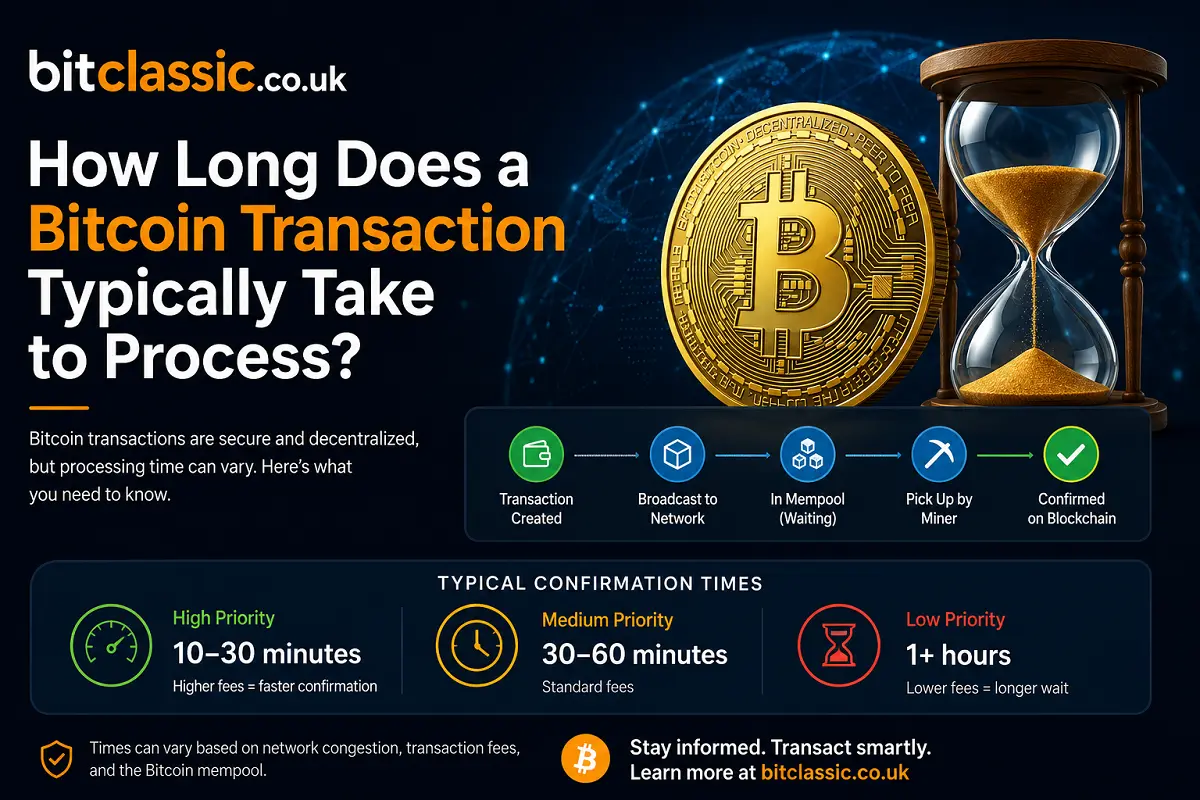
Phase 1: Broadcast. The moment you tap send, your wallet signs the transaction with your private key and broadcasts it to nodes across the Bitcoin network. This phase is nearly instant, usually a matter of seconds.
Phase 2: Mempool waiting. Your transaction now sits in the mempool, short for “memory pool,” a kind of holding area for unconfirmed transactions. Each node maintains its own mempool, and miners draw from it when assembling the next block. How long you wait here depends almost entirely on the fee you paid versus what other senders are paying.
Phase 3: Confirmation. A miner includes your transaction in a block and adds that block to the blockchain. That’s your first confirmation. Each subsequent block built on top adds another confirmation, deepening the security of your transaction. The Bitcoin protocol targets one new block roughly every ten minutes.
When someone asks how long Bitcoin takes, they’re usually asking about Phase 2 plus enough of Phase 3 to feel safe. For everyday transfers between wallets, one confirmation is often sufficient. For larger amounts or exchange deposits, the bar is higher.
The Standard Timeline: What to Expect in Normal Conditions
Under typical network load with a reasonable fee, here’s the realistic schedule:
0 to 10 minutes:
Your transaction enters the mempool and waits for the next block. The average wait is about 5 minutes because blocks are produced continuously.
10 to 20 minutes:
First confirmation. A miner has included your transaction in a freshly mined block. For low-value transfers, you can consider the payment effectively complete at this point.
20 to 60 minutes:
Confirmations two through six accumulate. Each one represents another layer, making it exponentially harder to reverse the transaction.
60+ minutes:
Six confirmations reached. This is the gold standard in the Bitcoin community for treating a transaction as fully irreversible, especially for high-value transfers.
It’s worth noting that the ten-minute block time is an average, not a guarantee. Individual blocks can arrive in under a minute or take more than half an hour, depending on the random nature of the proof-of-work mining process and the current network hashrate. According to recent network data, the average block confirmation time in May 2026 has occasionally stretched well beyond the ten-minute target during congested periods, with some daily averages exceeding 50 minutes.
Why Bitcoin Transactions Take Time: The Architecture Behind the Wait
Bitcoin’s transaction speed isn’t a bug; it’s a deliberate design choice. Understanding why the network operates this way helps make the wait feel less arbitrary.
Block Size and Block Time Constraints
Each Bitcoin block holds roughly 1 MB of transaction data, which translates to somewhere between 1,000 and 2,500 individual transactions, depending on how complex each one is. New blocks arrive on average every ten minutes. Do the math: that’s about two to five transactions per second across the entire global network.
For comparison, Visa processes thousands of transactions per second. Bitcoin’s throughput limit is intentional. The ten-minute block time gives nodes around the world enough time to propagate and verify each new block, preserving decentralization and security at the cost of raw speed.
The Mempool: A Real-Time Auction for Block Space
When more people want to send Bitcoin than the next block can fit, the mempool fills up. Miners select transactions based on fee rate, measured in satoshis per virtual byte (sat/vB). They have a straightforward economic motive: they take the highest-paying transactions first.
If your fee is below the current market rate, your transaction can sit in the mempool for hours, days, or, in extreme cases, never confirm. During the April 2021 bull run, average fees briefly hit around $59 as users competed for space. In quieter periods, you can confirm a transaction for a few cents.
Proof of Work and Hashrate Variability
Bitcoin uses proof-of-work consensus, meaning miners solve a computational puzzle to add each block. The difficulty adjusts every 2,016 blocks (roughly every two weeks) to keep the average block time at ten minutes, but short-term variance is normal. If the global hashrate drops, blocks slow down until the next difficulty adjustment compensates for it.
The Key Factors That Determine Your Transaction Time
Some variables are within your control, others aren’t. Here’s what shapes the wait.
Transaction Fees
This is the single biggest factor; fees on the Bitcoin network function like an auction. You’re bidding for inclusion in the next block, and miners pick the highest bidders.
Modern wallets offer fee tiers, typically labeled “high priority,” “medium,” and “low.” A high-priority fee aims to be included in the next one to three blocks, roughly 10 to 30 minutes. A medium fee targets the next few hours. A low fee accepts that you might wait until the network quiets down, which, during congestion, can mean overnight or longer.
Sites like mempool. space shows real-time fee recommendations based on current mempool conditions. Checking before you send takes ten seconds and can save you both time and money.
Network Congestion
When Bitcoin’s price moves sharply, or a major event drives trading volume, the mempool swells. Tens of thousands of transactions queue up, and even average fees can become “low” relative to the new competitive baseline. During heavy congestion, transactions paying yesterday’s fees can sit unconfirmed for a full day.
Transaction Size in Bytes
Bitcoin fees are calculated per virtual byte, not per dollar value. A transaction that combines many small inputs (called UTXOs) takes up more block space than one with a single large input, even if the amount being sent is identical. This means consolidating dozens of tiny Bitcoin holdings results in a larger, more expensive transaction than sending a single clean output.
If you’ve been receiving Bitcoin in small amounts over time, expect higher fees when you eventually send a large transfer. Wallet UTXO management features can help, but the underlying reality is straightforward: more inputs mean a bigger transaction.
Address Type
Bitcoin supports several address formats, and they aren’t equally efficient:
- Legacy addresses start with “1” and are the oldest format. They produce the largest transactions and the highest fees.
- SegWit addresses start with “3” (P2SH-wrapped) or “bc1q” (native SegWit, also called Bech32). Segregated Witness, activated in 2017, restructures transaction data to take up less block space.
- Taproot addresses start with “bc1p” and offer further efficiency gains, particularly for complex transactions.
If your wallet still uses legacy addresses, you’re paying more than you need to. Most modern wallets default to native SegWit or Taproot, which can reduce transaction size and fees by 30 to 40 percent.
Time of Day and Week
Bitcoin activity follows broadly predictable patterns. North American and European business hours tend to see heavier usage, while weekends and overnight periods (in those time zones) often have lighter mempools. If your transfer isn’t urgent, sending late on a Saturday can mean lower fees and faster confirmation.
How Many Confirmations Do You Actually Need?
The number of confirmations required depends on who’s receiving the Bitcoin and what’s at stake.
Confirmation Thresholds by Use Case
Personal wallet transfers: One confirmation is generally sufficient. The chance of a reversal at one confirmation is already very low.
Small purchases and tips: Many merchants accept zero-confirmation transactions for low-value items, especially when Replace-by-Fee (RBF) is disabled. There’s some risk of a double-spend, but for a coffee, the math usually works.
Exchange deposits: Most major exchanges require between one and six confirmations. Binance, for example, typically requires one confirmation for Bitcoin deposits and two for withdrawals. Coinbase usually waits for three confirmations before crediting funds.
Large transfers and institutional settlements: Six confirmations are the long-standing community standard. The probability of a six-block reorganization is vanishingly small, on the order of one in millions for any reasonable network state.
How Long Does Six Confirmations Really Take
Six confirmations × ten minutes per block = 60 minutes on average. In practice, expect 50-90 minutes once your first confirmation lands. If you sent a high-fee transaction during a quiet period, you might complete the whole cycle in under an hour. During congestion, six confirmations can easily take more than two hours.
When Your Transaction Gets Stuck: Practical Recovery Options
Sometimes you send a transaction, the fee is too low, and it sits in the mempool while you watch confirmations pile up. You have options.
Replace-by-Fee (RBF)
RBF is a Bitcoin protocol feature that lets you rebroadcast a transaction with a higher fee, replacing the original. The new transaction has the same effect, sending the same amount to the same recipient, but pays more to miners. Most modern wallets support RBF, though you usually have to enable it explicitly before sending.
If your wallet has a “Speed Up” or “Bump Fee” option on pending transactions, that’s RBF in action. The replacement transaction will have a new transaction ID, which can confuse recipients, but the original payment is effectively canceled and resent at the higher fee.
Child-Pays-for-Parent (CPFP)
If RBF isn’t available, perhaps because you didn’t enable it before sending, you can still accelerate a stuck transaction using CPFP. This works by creating a new transaction (the “child”) that spends an output from the stuck transaction (the “parent”) and pays a very high fee. Miners want the child’s fee, but they have to confirm the parent first to make the child valid. So both are clear together.
CPFP requires that you control one of the receiving addresses, which usually means you’re either the recipient or have a “change” output returned to your wallet. The recipient of a stuck payment can use CPFP to retrieve funds more quickly.
Just Wait
This sounds anticlimactic, but it’s often the right answer. Mempool congestion is cyclical. During heavy usage, fees spike. A few hours later, when activity drops, the backlog clears. Your low-fee transaction that looked hopeless at 3 PM might confirm naturally at 4 AM when the network quiets down.
If a transaction has been pending for more than 72 hours and your wallet doesn’t show it being dropped from the mempool, you can typically rebroadcast or use one of the methods above. Most nodes will drop transactions from their mempool after about two weeks if they remain unconfirmed.
Beyond the Base Layer: The Lightning Network
If you regularly need fast, cheap Bitcoin transactions, the base blockchain isn’t your only option. The Lightning Network is a second-layer protocol built on top of Bitcoin that handles transactions off-chain through payment channels.
How Lightning Works in Practice
Two parties open a payment channel by locking funds in a multi-signature address on the main Bitcoin blockchain. From that point on, they can transact with each other an unlimited number of times, instantly and at near-zero cost. Only the final balance is settled back to the main chain when the channel closes.
Lightning transactions complete in milliseconds and typically cost a fraction of a penny. They’re ideal for small, frequent payments, such as tipping content creators, paying for streaming services, or settling restaurant tabs. For large transfers or long-term storage, the base layer remains the standard.
The catch: both sender and receiver need Lightning-compatible wallets, and the network has its own learning curve. Channel management, liquidity, and routing are all considerations Lightning users need to understand. That said, custodial Lightning services like Wallet of Satoshi or Cash App have made the experience nearly indistinguishable from sending a regular payment via a mobile app.
Practical Tips for Faster Bitcoin Transactions
Drawing all of this together, here are the steps that actually move the needle:
Check the mempool before sending. Mempool.space and similar explorers show current fee rates by confirmation target. A 30-second check can save you an hour of waiting.
Use a SegWit or Taproot wallet. If your wallet still produces addresses starting with “1,” consider switching. The fee savings compound over time.
Enable RBF before sending. It costs nothing and gives you an escape hatch if you misjudge the fee.
Match your fee to the urgency. Paying for next-block inclusion when you don’t need it is a waste. Paying for next-day inclusion when you’re trying to fund a time-sensitive trade is false economy.
Consider Lightning for repeated small transfers. If you make frequent low-value payments, the setup is worth it.
Avoid sending during obvious congestion spikes. Major price moves, exchange listings, and global news events often coincide with mempool surges.
Frequently Asked Questions
How long does a Bitcoin transaction take to confirm in 2026?
Under normal conditions, a Bitcoin transaction receives its first confirmation in about 10 to 20 minutes and reaches six confirmations within roughly an hour. During heavy congestion, this can stretch to several hours. The exact time depends on the fee paid, current mempool size, and how many confirmations the recipient requires.
Why is my Bitcoin transaction taking so long?
The most common reason is that you paid a fee below the current market rate for block space. Other factors include unusually high network congestion, an unusually slow block being mined, or a large transaction with many inputs that takes more space. Check a mempool explorer to see the current fee landscape, then consider using Replace-by-Fee to bump your transaction if it’s been stuck for hours.
Can a Bitcoin transaction fail or be lost?
A properly signed transaction is never truly lost. If it doesn’t confirm within about two weeks, most nodes will drop it from their mempool, at which point your wallet treats the funds as available again. Until then, the transaction sits in pending limbo. There’s no scenario in which Bitcoin “disappears” mid-transaction; the protocol guarantees that funds are either at the sending address or have been successfully transferred.
What’s the fastest way to send Bitcoin?
For on-chain transactions, paying a high-priority fee gets you into the next block, typically within 10 to 20 minutes. For genuinely instant transfers, the Lightning Network completes payments in milliseconds at minimal cost, though both parties need compatible wallets.
Does paying a higher fee guarantee faster confirmation?
It dramatically improves your odds, but doesn’t guarantee anything. Miners select transactions based on fee rate, so paying above the current top tier essentially guarantees inclusion in the next block. However, the next block itself might take 5 minutes or 25 minutes to be mined; that’s probabilistic.
How many confirmations should I wait for before considering a Bitcoin transaction final?
For personal use, one confirmation is usually fine. For exchange deposits, follow the exchange’s policy, typically one to three confirmations. For large transfers or settlements where reversibility risk matters, six confirmations is the traditional standard and is essentially irreversible.
What is the Bitcoin mempool, and how does it affect my transaction?
The mempool is the queue of unconfirmed transactions awaiting inclusion in a block. Each Bitcoin node maintains its own copy. When the mempool is large, competition for block space drives up fees and slows down low-fee transactions. When the mempool is small, even modest fees confirm quickly.
Can I cancel a pending Bitcoin transaction?
Technically, you cannot cancel a broadcast transaction, but you can replace it if you enabled Replace-by-Fee when sending. RBF lets you send a new transaction with a higher fee that supersedes the original. If RBF wasn’t enabled and the original transaction is genuinely unconfirmed, you can sometimes wait for the network to drop it (usually after about two weeks) and then resend.
Why does Bitcoin take so much longer than newer cryptocurrencies?
Bitcoin’s ten-minute block time and 1 MB block size limit are deliberate design choices that prioritize decentralization and security over raw speed. Newer chains often make different tradeoffs, accepting more centralization or different consensus mechanisms in exchange for faster confirmations. Neither approach is universally better; they’re optimized for different priorities.
Do exchanges process Bitcoin withdrawals instantly?
No. Exchanges still need to broadcast withdrawals to the Bitcoin network and wait for confirmations, as with any other transaction. Many exchanges batch multiple user withdrawals into a single transaction to save on fees, which can add internal processing delays. Expect total withdrawal times of 30 minutes to several hours,s depending on the exchange’s policies and network conditions.
The Bottom Line
A Bitcoin transaction typically takes 10 to 60 minutes to process under normal conditions, with the exact time governed by network congestion, the fee you pay, and how many confirmations your recipient needs. The system is designed this way on purpose; ten minutes of waiting is the price Bitcoin pays for a decentralized network that has never been compromised in its 17-year history. For most users, the practical playbook is straightforward: check the current mempool before sending, use a SegWit or Taproot wallet, enable Replace-by-Fee, and match your fee to your actual urgency. If you regularly need instant payments, the Lightning Network offers a fundamentally different speed profile while still settling on Bitcoin’s base layer. Bitcoin will never match the throughput of a centralized payment processor, and that’s the point. What it offers in return is a settlement layer that operates without permission, runs 24/7, and finalizes value transfers anywhere in the world for a predictable fee. Once you understand the timing model, the wait becomes less of an inconvenience and more of a feature you’ve learned to work with.
For any suggestions or changes, please contact us.