
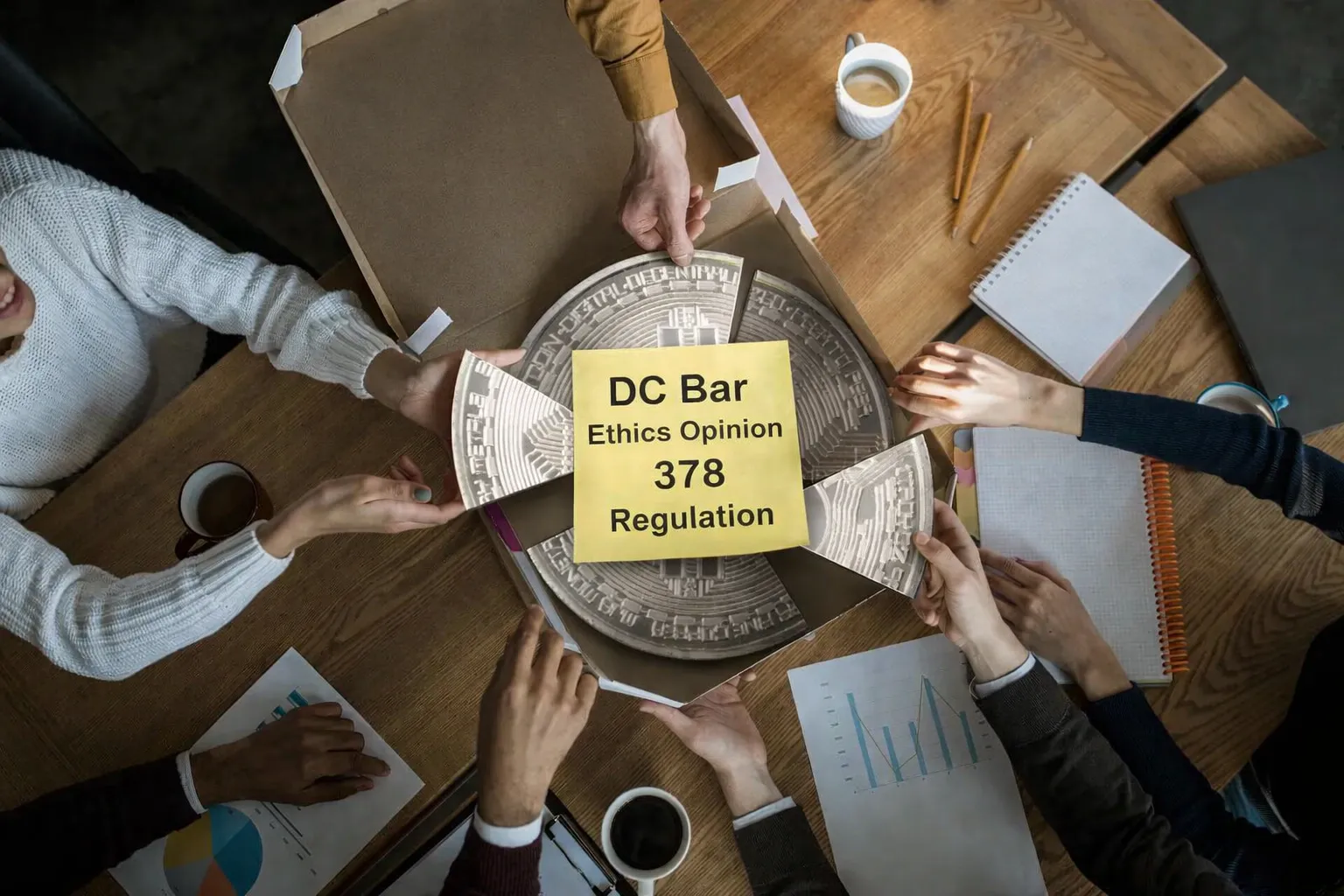
What Is DC Bar Ethics Opinion 378?
DC Bar Ethics Opinion 378, formally titled “Acceptance of Cryptocurrency as Payment for Legal Fees,” was issued in June 2020 by the District of Columbia Bar Legal Ethics Committee. It is the authoritative guidance document for D.C.-licensed attorneys on whether, and under what conditions, they may accept Bitcoin, Ethereum, and other digital assets as payment for legal services.
The opinion was the fourth of its kind issued by a U.S. bar association, following Nebraska (2017), North Carolina (2019), and New York County (2019). It has since been cited approvingly by the Virginia State Bar Standing Committee on Legal Ethics in drafting Virginia Legal Ethics Opinion 1898 (2022), and it is referenced in American Bar Association CLE programs on cryptocurrency ethics.
Why it matters now: Cryptocurrency has moved from a niche technology to a mainstream payment method. As digital assets such as Bitcoin and Ethereum are increasingly accepted across industries, attorneys can no longer treat the question of crypto payments as a hypothetical. Opinion 378 is the binding ethical framework for D.C. practitioners navigating this landscape.
The Core Holding: Is It Ethical to Accept Crypto?
The Committee’s answer is unambiguous: it is not unethical for a lawyer to accept cryptocurrency instead of more traditional forms of payment, so long as the fee is reasonable.
However, the Committee identifies two scenarios that trigger heightened ethical obligations:
- Advance fees in cryptocurrency, accepting crypto before services are rendered.
- Cryptocurrency received in settlement, holding a client’s crypto as part of a claim resolution.
In both cases, compliance with D.C. Rules of Professional Conduct, specifically Rules 1.1, 1.5, 1.8, and 1.15, is non-negotiable. The opinion makes clear that the Rules are “flexible enough to provide for the protection of clients’ interests and property” even in the context of a novel payment medium.
Cryptocurrency as Property, Not Currency
One of the most consequential analytical moves in Opinion 378 is its classification of cryptocurrency. The Committee concludes:
Payment of fees in cryptocurrency is more akin to payment in property than payment in fiat currency.
This classification is not merely academic; it has direct practical consequences for how attorneys must handle digital assets:
- Valuation complexity: Unlike a dollar, the value of one Bitcoin changes by the minute. Attorneys must decide whether the fee is denominated in dollars (with crypto as the payment vehicle) or in units of cryptocurrency.
- Business transaction rules apply: Because crypto is treated as property, accepting an advance retainer in cryptocurrency triggers Rule 1.8, which governs business transactions between a lawyer and a client.
- Trust accounting differs: Standard IOLTA trust account rules assume fiat currency. Cryptocurrency requires bespoke safeguarding that goes beyond depositing funds in an insured bank account.
The Committee drew an analogy to a prior D.C. Bar opinion addressing stock received as an ownership-in-lieu-of-fees arrangement. In that context, the Committee had concluded that reasonableness “would be measured, at least in part, by the extent to which the client’s acceptance of the fee arrangement was informed by its understanding of the financial implications.” The same principle applies with full force to cryptocurrency.
Rule 1.5: The Reasonableness Standard
Rule 1.5(a) of the D.C. Rules of Professional Conduct states that a lawyer’s fee must be reasonable. The rule sets out factors for determining reasonableness, including the nature of the representation, the attorney’s experience, and the client’s sophistication. Opinion 378 applies these factors to crypto payment arrangements with two key considerations:
1. Valuation at the Time of Payment vs. Time of Earning
The opinion identifies valuation as one of the most challenging aspects of crypto fee arrangements. Because cryptocurrency can fluctuate dramatically in value between the time it is received and the time services are earned, attorneys must decide upfront:
- Will the fee be denominated in dollars and the crypto converted at the time of receipt?
- Will the fee be denominated in cryptocurrency, with the client absorbing or benefiting from subsequent price movement?
- Will the attorney immediately convert the cryptocurrency to fiat upon receipt?
Each choice carries different ethical implications. Immediate conversion eliminates valuation uncertainty and is the approach most favorable to both parties. However, the opinion does not mandate it.
2. Disclosure of Financial Implications
A fee arrangement is not reasonable unless the client genuinely understands it. The opinion emphasizes that clients must be informed in writing of the financial implications of paying fees in cryptocurrency, including the volatility risk, the possibility that the crypto will appreciate or depreciate significantly, and how disputes over value will be resolved.
Rule 1.8: The Business Transaction Trigger
This is where Opinion 378 breaks significant new ground. The Committee holds that when an attorney accepts cryptocurrency as an advance fee (i.e., payment before services are rendered), this constitutes a business transaction with a client for purposes of Rule 1.8.
Rule 1.8(a) provides that a lawyer must not enter into a business transaction with a client unless:
- The transaction and its terms are fair and reasonable to the client and are fully disclosed in writing in a manner the client can understand;
- The client is given a reasonable opportunity to seek advice from independent counsel; and
- The client provides informed consent in writing.
Why does an advanced crypto payment trigger Rule 1.8? The Committee’s reasoning is precise: because of the considerable uncertainty about the future value of cryptocurrency at the time the fee will be earned, “the lawyer and client are entering into a potentially adverse pecuniary relationship.” Both parties are, in effect, betting on where the asset price will go, and those interests may diverge.
This is materially different from accepting a check. When you accept $5,000 in cash, the fee is fixed. When you accept 0.1 Bitcoin at a moment when it’s worth $5,000, the actual value of your fee, and the effective cost to your client, could be dramatically different by the time you do the work.
What Rule 1.8 Requires in Practice
For an attorney accepting cryptocurrency as an advance fee, compliance with Rule 1.8 requires:
- A written disclosure describing the nature and terms of the crypto arrangement, including all risks associated with price volatility
- Informing the client of their right to seek independent legal counsel before agreeing to the arrangement
- Obtaining written consent from the client after these disclosures
Rule 1.15: Safeguarding Client Cryptocurrency
Rule 1.15 governs the safekeeping of client property. For standard retainers, this means placing unearned funds in an IOLTA trust account. Cryptocurrency cannot go into an IOLTA account; it requires a different approach.
Opinion 378 makes clear that attorneys who hold a client’s cryptocurrency, whether as an advance fee or in settlement, must take competent and reasonable security precautions to protect the digital assets. The opinion’s discussion of security risks is pointed:
- Blockchain transactions are unregulated, uninsured, anonymous, and irreversible
- Cryptocurrency is regularly targeted for digital fraud and theft
- Online wallets and exchange platforms may be fraudulent or hacked
- A digital (hot) wallet connected to an online network is vulnerable to malware
- The private key is critical: if lost or stolen, the cryptocurrency may be permanently inaccessible
- Unlike funds in a lawyer’s trust account, cryptocurrency is not FDIC-insured
These are not theoretical risks. Law firms have been targeted by ransomware, fraudulent wire transfer instructions, and account takeovers. Cryptocurrency amplifies these threats because transactions are irreversible.
Rule 1.1: The Duty of Technological Competence
Opinion 378 affirms that accepting cryptocurrency is not simply a billing question; it is a competence question. Consistent with D.C. Bar Legal Ethics Opinion 371 (addressing lawyers’ use of social media), the Committee concludes that attorneys must possess the skill required to exercise reasonable professional judgment about technology, including digital currency.
Citing ABA Comment [8] to Model Rule 1.1, the opinion instructs that, to be competent, a lawyer must “keep abreast of changes in the law and its practice, including the benefits and risks associated with relevant technology.”
Practical implication: An attorney cannot simply hand their billing coordinator a cryptocurrency wallet address and hope for the best. Lawyers who accept crypto must have a working understanding of:
- How blockchain transactions work
- The difference between custodial and non-custodial wallets
- How to use hardware wallets (cold storage) for secure key management
- The tax implications of receiving cryptocurrency as income
- The firm’s obligations if a client’s crypto is lost or stolen while in the attorney’s custody
Advance Fees in Cryptocurrency: Special Requirements
When cryptocurrency is accepted as an advanced fee payment for services not yet rendered, the ethical obligations compound. The attorney must ensure:
- The fee arrangement is reasonable under Rule 1.5
- The arrangement is objectively fair to the client under Rule 1.8
- The client has been informed in writing of the financial implications
- The client has been allowed to seek independent counsel
- Written consent has been obtained from the client
- The cryptocurrency is safeguarded under Rule 1.15 until earned
This is a high standard. The opinion makes no apology for that. The Committee acknowledges that cryptocurrency raises unique challenges “that simply do not exist with fiat currency”, and the ethics rules respond to those challenges by requiring heightened disclosure and client protection.
Refund Obligations
The advance fee rules under Rule 1.16(d) also apply. If representation ends before the advance fee is fully earned, the attorney must return any unearned portion. With cryptocurrency, this creates a complication: what happens if the crypto has appreciated or depreciated since it was received? The fee agreement should address this explicitly.
Settlement Proceeds Paid in Cryptocurrency
Opinion 378 also addresses the scenario where a client’s legal claim is settled, and the opposing party pays in cryptocurrency. In this case, the attorney who takes possession of the cryptocurrency is holding client property under Rule 1.15, not payment for their own services.
The same security precautions apply. The cryptocurrency must be:
- Held separately from the attorney’s own assets
- Protected from loss, theft, damage, or destruction
- Transferred to the client promptly once the settlement is finalized
If the attorney is also taking their fee from the settlement proceeds, the intersection of Rules 1.5, 1.8, and 1.15 all apply simultaneously. Careful documentation is essential.
What Must Be in the Written Fee Agreement
Opinion 378 recommends that attorneys accepting cryptocurrency consider including the following in their fee agreements:
- How the client will be billed, in dollars, in units of cryptocurrency, or some combination
- Whether the fee will be marked to market, will the attorney convert immediately upon receipt, or hold the cryptocurrency?
- Whether the client will receive a refund in dollars or cryptocurrency if representation ends before the fee is earned, and at what exchange rate
- An explanation of the risks associated with price volatility, including both upside and downside scenarios
- Security arrangements – how the attorney will store and protect the cryptocurrency
- Tax implications – disclosure that receiving cryptocurrency may have tax consequences for both parties
- Dispute resolution – how valuation disputes will be resolved if the cryptocurrency changes dramatically in value before services are complete
The more detailed and transparent the agreement, the stronger the attorney’s position if the client later challenges the fee arrangement.
Security Best Practices: Hot Wallets vs. Cold Wallets
Opinion 378 explicitly references the security risks of cryptocurrency custody. Attorneys must choose their storage method deliberately:
Hot Wallets (Online Storage)
Hot wallets are connected to the internet. They are convenient but significantly more vulnerable to hacking, phishing, and malware. Examples include exchange accounts (Coinbase, Kraken) and browser-based wallets.
Ethical risk: If client funds held in a hot wallet are stolen, the attorney may face a Rule 1.15 violation for failing to take reasonable security precautions.
Cold Wallets (Offline Storage)
Cold wallets store the private key offline, either on a hardware device (like a Ledger or Trezor) or on paper. They are far more secure against remote attacks but carry physical risks (loss, damage, destruction).
Opinion 378 and Virginia Legal Ethics Opinion 1898 both note that cold wallets, while more secure, can still be “lost, stolen, damaged, or destroyed”, and attorneys must account for this. Backup procedures and secure physical storage are essential.
Recommended Protocol
Most ethics commentary recommends that attorneys holding client cryptocurrency:
- Use a hardware cold wallet for any amount held longer than a brief period
- Maintain encrypted backups of private keys in geographically separate secure locations
- Never share private keys with unauthorized personnel
- Document the security measures taken in writing
How Other Jurisdictions Compare
DC Bar Ethics Opinion 378 does not stand alone. Understanding how other jurisdictions have approached the same question clarifies both the consensus view and the areas of divergence.
Nebraska (Ethics Advisory Opinion 17-03, 2017)
Nebraska was the first state bar to address the issue. It took the most conservative position: attorneys may accept cryptocurrency as payment, but must immediately convert it to fiat currency upon receipt. This eliminates volatility risk but denies the attorney the option of holding crypto.
North Carolina (Formal Ethics Opinion 5, 2019)
North Carolina reached a similar conclusion but applied a different analytical framework. Unlike D.C., North Carolina did not find that accepting an advance fee in cryptocurrency triggers Rule 1.8’s business transaction requirements. This represents a meaningful doctrinal difference.
New York County Lawyers Association (2019)
New York County issued guidance permitting cryptocurrency payments subject to fee reasonableness requirements, with emphasis on disclosure.
Virginia (Legal Ethics Opinion 1898, 2022)
Virginia’s opinion closely tracks D.C.’s approach and cites Opinion 378 approvingly. Virginia concluded that a lawyer may accept cryptocurrency as an advance payment provided the requirements of Rule 1.8(a) are met, including written disclosure, fairness to the client, and written consent.
California (Pending/Evolving, 2022–present)
California’s State Bar Standing Committee on Professional Responsibility issued guidance that engages extensively with Opinion 378, largely adopting its analytical framework. California’s volatile legal technology market makes this a particularly active area.
The National Picture
The majority of bar ethics opinions that have addressed the question permit cryptocurrency payments, subject to disclosure and competence requirements. No jurisdiction has categorically prohibited it. The consensus view, shared by D.C., Virginia, New York, and California, is that cryptocurrency raises unique challenges but is not categorically impermissible.
Practical Compliance Checklist
Before accepting cryptocurrency as legal fees, use this checklist to ensure compliance with Opinion 378:
Before the Representation Begins
- Assess whether you have sufficient technological competence to accept and hold cryptocurrency (Rule 1.1)
- Identify the specific cryptocurrency to be accepted and understand its characteristics
- Determine how fees will be denominated (in dollars or in crypto units)
- Decide on your custody and security approach (hot wallet vs. cold wallet)
- Consult with a tax advisor regarding income recognition rules
In the Fee Agreement
- Disclose that the fee arrangement involves cryptocurrency and explain the implications
- Specify the exchange rate or conversion methodology
- Describe what happens to unearned fees if representation ends
- Address price volatility risk explicitly
- Inform the client of their right to seek independent counsel before signing
- Obtain written consent
For Advance Fee Arrangements
- Ensure the arrangement is objectively fair to the client (Rule 1.8)
- Confirm written disclosure of all terms has been provided
- Confirm written consent has been obtained
- Establish a safeguarding protocol for unearned cryptocurrency (Rule 1.15)
Ongoing During Representation
- Maintain records of cryptocurrency received, including date, amount, and USD equivalent at time of receipt
- Follow your established security protocol for storing private keys
- Monitor regulatory developments that may affect your obligations
- Keep abreast of changes in blockchain technology relevant to your practice
Frequently Asked Questions
Q: Can a D.C. attorney require clients to pay in cryptocurrency?
A: The opinion does not categorically prohibit it, but requiring cryptocurrency payment raises additional questions about whether such a requirement is “fair and reasonable” to the client, particularly for unsophisticated clients unfamiliar with digital assets. Attorneys should proceed with caution and ensure robust disclosure.
Q: Does Opinion 378 apply only to Bitcoin?
A: No. The opinion addresses “cryptocurrency” broadly, covering all digital assets that function as a medium of exchange on a blockchain network. This includes Ethereum, stablecoins, and other cryptocurrencies, though the volatility analysis may differ for stablecoins pegged to fiat currency.
Q: What if a client sends cryptocurrency without a prior agreement?
A: An attorney who receives unsolicited cryptocurrency must promptly address the situation, either by establishing a compliant fee arrangement retroactively (including all required disclosures and consents) or by returning the cryptocurrency. Simply holding unsolicited crypto creates significant ethical risk.
Q: Can the attorney hold the client’s cryptocurrency in the same wallet as their own?
A: No. Rule 1.15 requires that client property be held separately from the attorney’s own assets. Client cryptocurrency must be in a separate, dedicated wallet.
Q: What happens if the exchange or wallet holding client crypto is hacked?
A: The attorney’s liability will depend on whether they took “competent and reasonable security precautions” as required by Opinion 378. Attorneys who relied on inadequate security, for example, storing client crypto in an exchange with a known history of security failures, may face disciplinary exposure.
Q: Does Opinion 378 address NFTs or other digital assets beyond traditional cryptocurrency?
A: The opinion predates the 2021 NFT boom and does not address non-fungible tokens specifically. However, the underlying analytical framework, treating digital assets as property subject to Rules 1.5, 1.8, and 1.15, applies broadly and would likely govern NFT-related fee arrangements as well. Attorneys should proceed under the same framework until further guidance is issued.
Q: Are there tax reporting requirements when accepting cryptocurrency?
A: Yes. The IRS treats cryptocurrency as property for federal tax purposes. Receiving cryptocurrency as income triggers recognition at the fair market value on the date of receipt. Attorneys must track the cost basis for each unit received. This is a question for a tax professional, but it is relevant to the fee agreement because both parties should understand the tax implications.
Conclusion
DC Bar Ethics Opinion 378 is one of the most practically significant ethics opinions issued in the digital era of legal practice. Its core message is clear: accepting cryptocurrency is permissible, but it demands a higher degree of client protection, disclosure, and technical competence than traditional payment methods.
The opinion’s classification of cryptocurrency as property rather than currency is the analytical foundation for everything else. That classification triggers the business transaction rules under Rule 1.8, elevates the duty to safeguard under Rule 1.15, and demands a level of technological fluency under Rule 1.1 that many attorneys have not yet developed.
For D.C. practitioners considering cryptocurrency payments, the path forward requires:
- Investing in a genuine technological understanding of how digital assets work
- Building written fee agreements that are transparent, detailed, and client-protective
- Adopting serious security protocols for private key management
- Staying current with evolving regulatory and ethical guidance
Attorneys who approach this thoughtfully, with robust disclosure and sound security practices, can accept cryptocurrency without compromising their professional responsibilities. Those who treat it as a billing novelty rather than a serious compliance matter do so at their ethical and reputational peril.